


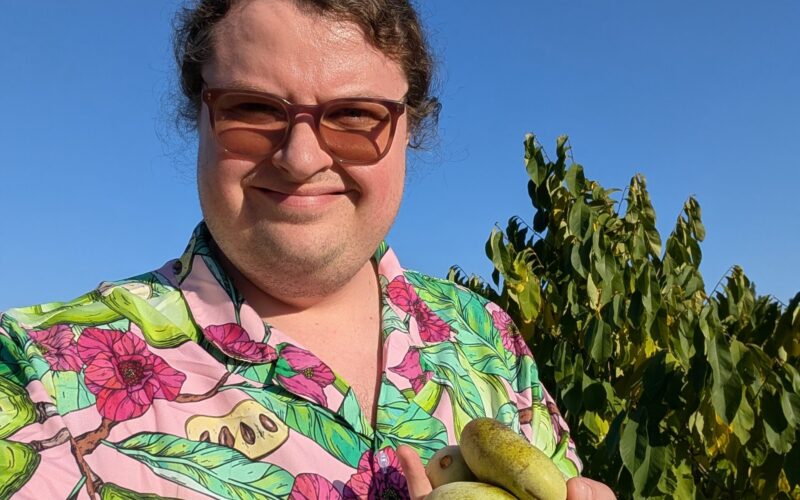
A local grower’s six-year labor of love has finally, and literally, borne fruit.
Troy Miller, a resident of Russells Point, is celebrating the first successful harvest from his backyard pawpaw patch, a milestone that marks a personal victory and contributes to the growing interest in Ohio’s unique native fruit.
Miller planted his first pawpaw seedlings in 2019, captivated by the challenge of cultivating the so-called “Ohio banana” or “poor man’s banana.”
This year, his patience and dedication were rewarded with the distinctive green, kidney-shaped fruits hanging from the branches of his trees.
“It has definitely been a lot of blood, sweat, and tears,” Miller admitted, standing among his thriving trees. “To say I wanted to give up multiple times would be an understatement. Several people told me I would not be successful, so proving them wrong was my main driver for motivation.”
The Challenge of a Native Giant
The pawpaw (Asimina triloba) is North America’s largest native fruit, with a flavor often described as a tropical blend of mango, banana, and custard.
Despite being native to the Midwest and Appalachian regions, it is notoriously difficult to cultivate commercially due to its specific needs.
“They’re fussy trees,” Miller explained. “They need well-drained but moist soil, plenty of shade when they’re young, and then more sun as they mature. But the biggest test is patience. You’re looking at a five to seven-year wait before you see a single fruit.”
Perhaps the most unique challenge is pollination.
Unlike many fruit trees, pawpaws are not pollinated by bees.
Instead, they rely on flies and beetles, which are less efficient.
Many growers, including Miller, resort to hand-pollination using a small paintbrush to transfer pollen from one flower to another, a tedious but often necessary process to ensure a good yield.
For those who have never tried one, the ripe pawpaw is a revelation.
Its creamy, custard-like texture and complex flavor are a direct contrast to the hardy Midwest landscape it calls home.
The fruit is highly nutritious, rich in vitamins, minerals, and antioxidants.
However, its delicate, perishable nature—it bruises easily and has a short shelf life—is why it’s rarely found in conventional supermarkets, making local growers like Miller all the more important.
Miller’s success is more than a personal achievement; it’s a nod to Ohio’s agricultural heritage and a potential inspiration for others.
His orchard adds a unique, sustainable feature to the local landscape in Russells Point.
“In an age of global supply chains, there’s something special about growing a fruit that is truly meant to be here,” he said. “It connects you to the land and the history of this area.”
Looking ahead, Miller has ambitious plans. He hopes to expand his patch with more cultivars, experiment with value-added products like pawpaw jam or ice cream, and perhaps one day offer seedlings to other aspiring growers in the community.
His ultimate goal is to inspire others to embrace the challenge.
“If I can stick with it and see results, anyone can,” he said with a smile. “It’s a long game, but the reward—that first sweet, homegrown bite—is absolutely worth the wait.”
This year’s harvest may be small, but it represents a huge payoff: a testament to what perseverance, passion, and a connection to the land can accomplish, right in a small patch of soil in Russells Point.
Article by Mary Alleger
Submitted by Troy Miller.


