The following has been submitted by the Logan County History Center:
By Mary E. Mortimer:
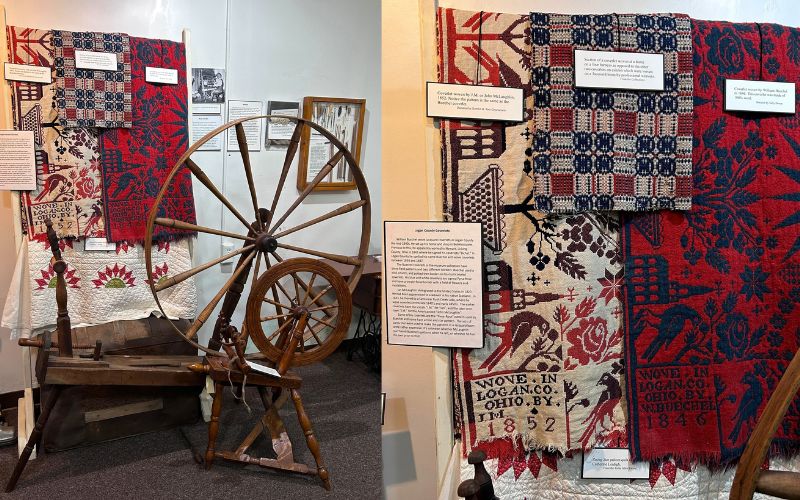
In the early 1830s, Logan County was largely engaged in sheep raising and wool production. Before a formal market developed, farmers maintained small flocks primarily for household use. Wool was spun at home on spinning wheels and made into clothing. Women wore wool or linsey‑woolsey dresses depending on the season, men wore wool trousers and coats, and all members of the family wore wool hosiery.
Hand‑spun wool was often taken to skilled weavers who crafted it into intricate Jacquard coverlets. From 1844 to 1847, William Buechel produced these coverlets in his Bellefontaine home. Ian and Margaret McLaughlin, who immigrated from Scotland in 1820, first settled in Greene County before moving to a farm near Rush Creek Lake in 1833. Ian, who had apprenticed as a weaver in Scotland, continued producing coverlets into the late 1840s and early 1850s. His early work is marked with the initials “I.M.” for Ian, while later pieces display “J.M.” after he adopted the Americanized name John McLaughlin. The Buechel and McLaughlin coverlets share strong similarities, leading to the belief that McLaughlin may have purchased Buechel’s patterns after Buechel ended his weaving career and left Logan County.
In 1837, Raphael Moore, of Union Township, introduced Saxony Merino sheep from Pennsylvania and significantly improved his flock. The price of sheep at that time was about 50 cents per head after shearing. By 1838, wool sold for about 20 cents per pound, with quality sheep producing roughly three‑pound fleeces. Choice wethers brought in about 65 cents each. Significant advancements in the wool industry began in the mid‑1850s.
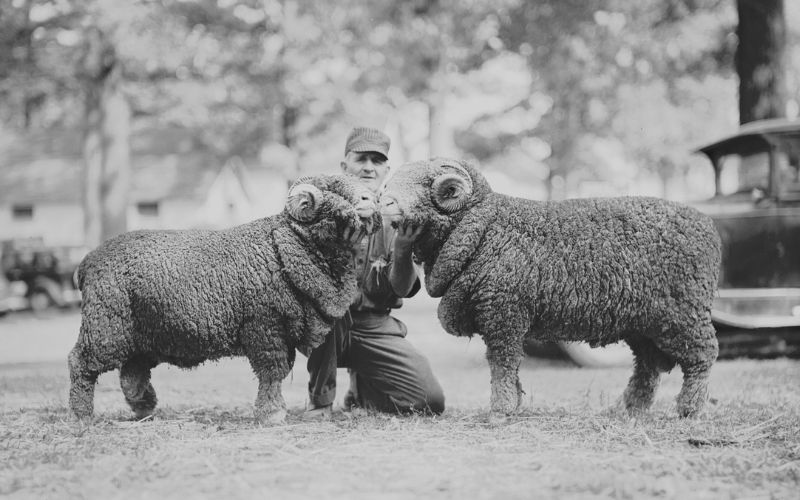
Around 1854, Solomon Cook, of Union County, brought Vermont Merino sheep to Logan County for breeding purposes. In 1860, Spanish Merino sheep were introduced from New England. These small, hardy sheep produced fine wool and adapted well to Ohio’s climate. During this period, farmers often paid $100–$500 for a single breeding ram. Selective breeding improved wool quality and market value.
According to Gen. Robert P. Kennedy’s “Historical Review of Logan County, Ohio” (1903), one of the most profitable breeds in the region was the Delaine, a pure Merino developed from selected stock. George A. Henry and William Horn were among the first local breeders to improve the variety. At that time, the Delaine Association of Ohio had flocks numbering more than sixteen thousand.
In August 1875, the Logan County Republican reported that the C. Rabbitts & Co. Mill, originally established in 1847 in Springfield, was being moved to Bellefontaine and renamed the Bellefontaine Woolen Mills. Two substantial brick buildings were erected on Patterson Avenue to accommodate the operation. The Bellefontaine Woolen Mills was renowned for producing high‑quality jeans and exceptionally fine yarn, with a single pound capable of being spun into a thread more than ten miles long. The mill was later destroyed by fire in April 1885.
The Logan County Index noted in May 1880 that the Mad River Woolen Mills operated fifteen knitting machines, with plans to expand to twenty‑five, enabling production of fifty dozen pairs of hosiery per day. Located midway between Zanesfield and West Liberty, the mill also produced cloths, cassimeres, satinets, tweeds, blankets, flannels, and yarns at competitive prices.
Judge William Lawrence was among Logan County’s most influential wool growers. His career included service in the Ohio Legislature, the Common Pleas and Third District Courts, the U.S. Congress, and as the first Comptroller of the U.S. Treasury. He also played a key role in assisting Clara Barton in founding the American Red Cross.
Lawrence served as a delegate to the national wool growers’ conventions in St. Louis (1887) and Washington, D.C. (1888 and 1889). He was elected president of the Ohio Wool Growers Association in 1891 and president of the National Wool Growers Association in 1893, holding both positions until his death in 1899.
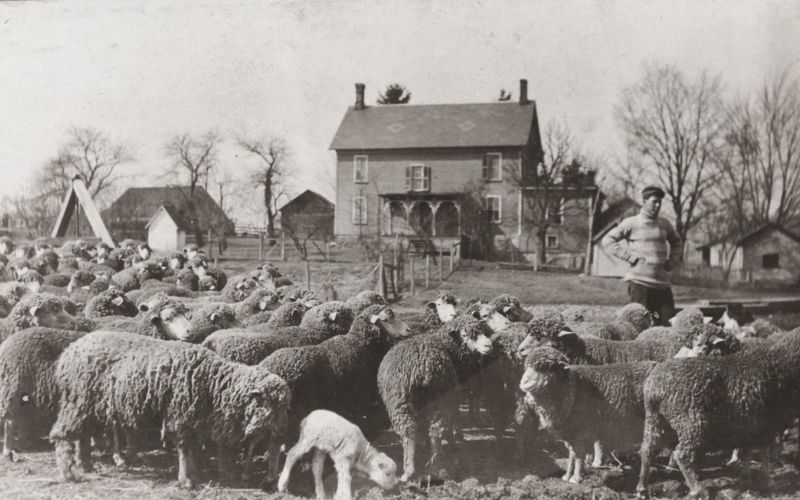
By 1893, Logan County supported several woolen mills and nearly 60,000 sheep, producing about 300,000 pounds of wool each year. By 1900, however, falling wool prices led to a sharp decline in sheep numbers, with fewer than 30,000 remaining and annual production dropping to roughly 148,000 pounds. As a result, many farmers shifted from raising sheep for wool to raising them primarily for meat.
Visit the Logan County History Center to learn more interesting aspects of Logan County History. The History Center is open for tours Wednesday – Sunday from 1:00 pm to 4:00 pm. Admission is free.