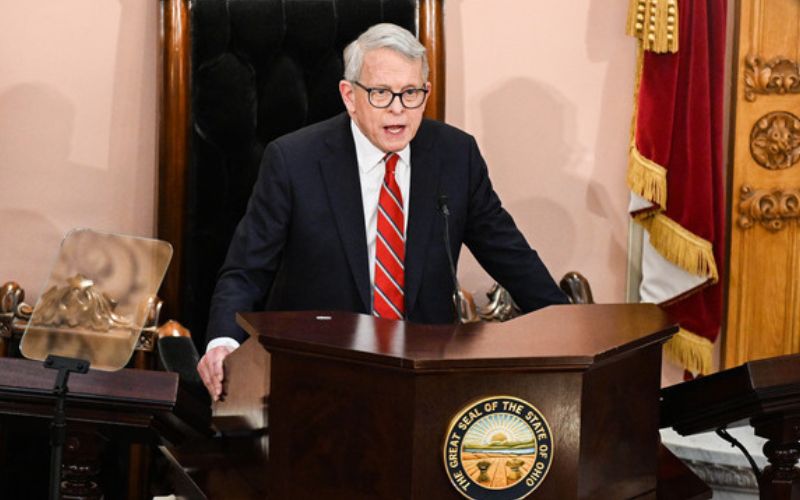
Ohio Governor Mike DeWine signed the following bills into law:
- House Bill 20, sponsored by State Representative Thomas Hall (R-Madison Twp.) and State Representative Phil Plummer (R-Dayton), to modify the offense of obstructing official business when the victim is an emergency service responder, to increase the penalty for obstructing official business when the victim is an emergency service responder who is engaged in the lawful performance of a legal duty, and to clarify that heightened penalties apply for menacing a probation officer.
- House Bill 105, sponsored by State Representative Meredith Craig (R-Smithville) and State Representative Jim Thomas (R-Jackson Township), to revise and supplement state regulations concerning non-recourse litigation funding agreements.
- House Bill 195, sponsored by State Representative Dani Isaacsohn (D-Cincinnati) and State Representative Adam Mathews (R-Lebanon), to make changes to the Ohio Uniform Commercial Code and to make changes regarding billing for reimbursement of pay for retired judges serving as active judges.
- House Bill 210, sponsored by State Representative Bill Roemer (R-Richfield) and State Representative Phil Plummer (R-Dayton), regarding the sale of used catalytic converters.
- House Bill 251, sponsored by State Representative Bernard Willis (R-Springfield), to establish requirements related to the use and purchase of an unmanned aerial vehicle by law enforcement and other public entities and to expressly incorporate additional aviation facilities into the Aeronautics Law.
- House Bill 292, sponsored by State Representative Ty D. Mathews (R-Findlay) and State Representative Nick Santucci (R-Niles), to establish the Ohio Defense and Space Advisory Commission and the Defense and Aerospace Industries Expansion Program, under which the Department of Development may make grants, and to make an appropriation.
- House Bill 297, sponsored by State Representative Kevin Ritter (R-Marietta) and State Representative Johnathan Newman (R-Troy), to increase the amount a county may provide to military and veterans organizations, and civic organizations, for Memorial Day expenses.
- House Bill 433, sponsored by State Representative Roy Klopfenstein (R-Haviland) and State Representative Sarah Fowler Arthur (R-Ashtabula), to revise various laws governing agriculture.
- House Bill 492, sponsored by State Representatives Sharon Ray (R-Wadsworth) and State Representative Cindy Abrams (R-Harrison), to expand the prohibition against interfering with arrest to all motor vehicle-related laws and require drivers and passengers to disclose their name, address, and date of birth to a peace officer on request.
- House Bill 533, sponsored by State Representative Kevin D. Miller (R-Newark), to add to the list of vehicles that can be used to commit a vehicular homicide or vehicular assault.
- House Bill 541, sponsored by State Representative Riordan T. McClain (R-Upper Sandusky), to designate a portion of U.S. Route 42 in Morrow County as the “Deputy Daniel “Weston” Sherrer Memorial Highway.”
- Senate Bill 276, sponsored by State Senator Kristina D. Roegner (R-Hudson),to ratify the Interstate Compact for School Psychologists, to modify the Interstate Massage Compact (IMpact), to require, instead of permit, continuing education for massage therapists, regarding the success sequence curriculum, to require the Department of Education and Workforce to submit a report regarding a single, statewide hybrid assessment system, and to enact the Student Athlete Mobility (SAM) Act regarding student petitions to participate in extracurricular activities at neighboring public schools.
- Senate Bill 315, sponsored by State Senator Tim Schaffer (R-Lancaster) and State Senator Hearcel F. Craig (D-Columbus), to ratify the Interstate Compact for School Psychologists, to modify the Interstate Massage Compact (IMpact), regarding program integrity for certain components of the Medicaid program, regarding the authority of the Attorney General and Auditor of State, to require Ohio’s SNAP program to begin using chip-enabled EBT cards, and to name section 5101.542 of the Revised Code as amended in this act and section 5101.5411 of the Revised Code as enacted in this act the Enhanced Cybersecurity for SNAP Act and to name the remainder of this act the Ohio Medicaid Program Integrity and Fraud Prevention Act.
|
|
|
|
|
|