
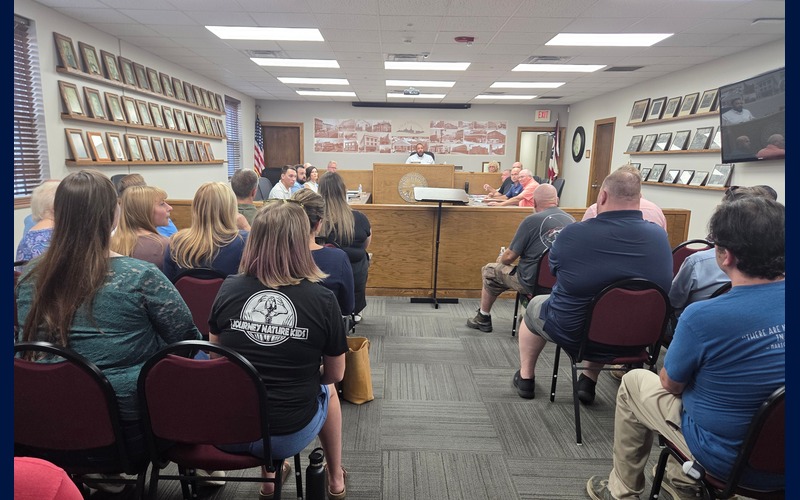
A near-capacity Bellefontaine Council chambers witnessed a rare procedural issue when two previously tabled ordinances, one the much-discussed ‘Golf Cart ordinance,’ and the other, a sound amplification ordinance, died before the council due to no motions being made to pass either.
Ordinance 26-31, the ordinance that would allow golf carts and other low-speed vehicles to operate in the city, and 26-32, the ordinance that would restrict sound amplification devices, were tabled by the council in July to solicit input and research language for both pieces of legislation.
City Law Director Josh Stolly informed the council that Council Rule 11 mandated that any tabled ordinance must be brought back before the council after 30 days. Stolly said, to his knowledge, neither ordinance has come out of committee, so he recommended that both be allowed to die.
Stolly discusses the procedural action:
In his report, Mayor David Crissman said that the recent city department picnic was very well attended, and he hoped the event would continue, as it builds and fosters community among city employees who may not interact with other departments.
Service-Safety Director Wes Dodds read a prepared statement to begin his report. In it, he acknowledged that while the recent rainfall caught everyone unprepared, it doesn’t take away from the fact that a key pump station on Michigan Avenue failed, causing damage to several homes.
Dodds also said that other residents who have been affected by flooding should not feel that their needs are being ignored. He urged all residents who experienced flooding issues to go to the city website and report the damage. Doing so may enable residents to be eligible for any state or federal funds that may come to the city in the future. The website can be found here.
Dodds’ full statement is below.
Dodds also said that six firms submitted flood mitigation plans to the city. The plans are being evaluated, and one will be selected to partner with the city to devise a plan to ease future flooding.
City Auditor Fred Brentlinger reported to the council that the appropriations ordinance up for the council’s consideration is needed because of a miscommunication between his office and the Human Resources Department. The extra funds, approximately $305,000, are needed to address a shortfall in city employees’ health insurance payments.
Police Chief Chris Marlow said that the recent Chicken BBQ netted almost $10,000 that will benefit the department’s K-9 program. He also said that he was informed that a current lieutenant will be retiring after the first of the year. As a result, a test for the open position will be held in October. Chief Marlow also said he expects two long-awaited cruisers to arrive this week.
Several residents addressed the council during the Communication from Citizens portion of the meeting. The topics addressed ranged from proponents of golf carts, flooding concerns, the Detrick addition, and one resident spoke out against the city utilizing Flock technology. Several residents who spoke about flooding issues were grateful for the city’s response and SSD Dodds’ responsiveness.
Several ordinances and one resolution were considered by the council:
Resolutions
R26-39 – A resolution authorizing the extension of public sewer and city water lines and services outside the corporation line of the City of Bellefontaine to serve approximately 7.5 acres being a portion of a larger parcel owned by Heath S. Allen, trustee. Resolution adopted.
The property is adjacent to the city on State Route 540. The site will be used for a house of worship. The cost for the extension, if requested, will be paid by the landowner.
Ordinances for 1st Reading
26-37 – An ordinance making supplemental appropriations and amending the Permanent Appropriations ordinance for purposes of group insurance. Motion to pass on 1st reading only. Motion passed.
26-38 – An ordinance amending the pay rate for Mac-A-Cheek Learning Center Seasonal School Resource Officer. Law Director Stolly recommended the ordinance be allowed to die so adjustments could be made. No motion was made to pass on 1st reading. Ordinance died.
Ordinances for 2nd Reading
26-31 – An ordinance establishing Section 331.46 of the Codified Ordinances of the City of Bellefontaine, Ohio, authorizing low-speed, under-speed utility vehicles and mini-trucks within said city. No motion was made to pass on 2nd reading. Ordinance died.
26-32 – An ordinance amending and restating Section 509.11, Sound Amplifying Devices and Loud Noises, of the Codified Ordinances of the City of Bellefontaine, Ohio. No motion was made to pass on 2nd reading. Ordinance died.
Ordinances for 3rd Reading
26-34 – An ordinance pursuant to section 709.38 of the Ohio Revised Code approving and assenting to the detachment of certain territory owned by Logan County from the City of Bellefontaine, Ohio and declaring an emergency. Motion to pass on 3rd and final reading passed. Ordinance adopted.
Full Statement from Wes Dodds
I want to take a moment to update you on where we stand following last week’s flooding and what comes next. Last Wednesday evening, Bellefontaine received an estimated four to five inches of rain in about three hours. We saw flooding in several areas of the city.
Last week, our focus was triaging the situation. We worked to get water away from homes, pump water out of affected areas, reopen streets, document damage, and put temporary protections in place. This week, we move into the investigation and recovery phase.
Before I get into Michigan Street and the work ahead, I want to recognize the people who responded. Our Street, Sewer and Water Department employees worked long hours throughout the event. Many worked through the night and into the following days. They pumped water, cleared streets, monitored conditions, helped residents and handled whatever else we needed. I want to publicly thank them.
I also want to thank Jeremy LeVan and the employees of LeVan’s Excavating. Once we located the large auxiliary pumps we needed, we still had to unload them, position them, connect them, and get them running quickly. Jeremy made his equipment and personnel available to us, and they worked alongside our crews to make that happen. Without that help, it likely would have been many more hours before we got those pumps in place.
I also want to thank Larry Park, the property owner to the south. When I had to make a phone call I didn’t want to make and say, “I’m sending a bunch of water in your direction,” he didn’t hassle me. He trusted me when I said we would make it right with him when the time came. Larry, I see you in the audience. Thank you for not making it harder than it had to be.
Finally, I want to thank the residents, especially on Michigan Street, whom I visited Wednesday night and throughout the day Thursday. You greeted me with more grace and patience than I think I could muster if I were in your shoes. I see a lot of you in the crowd. Thank you for the way you handled the situation.
We have plenty to review about what went wrong, but that should not take anything away from the people who responded. They worked hard under difficult conditions, and I appreciate what they did for our community.
The most serious situation remains on Michigan Street. Several years ago, the City built a project there to address recurring flooding. Residents were told it would protect their homes.
During last week’s storm, the water rose high enough to submerge an electrical converter that powers the pumps. The converter failed, which put the pumping system out of service. A section of the wall also failed. Water from the retention area rushed through the opening into the neighborhood, and six homes took on significant water as a result.
We immediately began looking for additional pumping capacity. We brought in three large auxiliary pumps from Cincinnati that evening and used them to significantly lower the water level. The permanent pumps are now operating on generator power. The electrical converter is being repaired, and when we reinstall it, it will be placed at a higher elevation to reduce the risk of this happening again.
We will remove two of the three large auxiliary pumps at the south end of the pond as conditions stabilize this week. We were out today, and the water is down significantly. We can actually see grass in the bottom of that pond for the first time in quite a while, with all the wet weather we’ve had.
We will leave one large auxiliary pump on site as an emergency backup until we have a permanent solution. We are also looking at purchasing a larger dewatering pump so the City has that capability available when we need it in the future.
We installed temporary water-filled barriers behind the affected homes on the east side of Michigan Street. These are temporary measures. They give those homes additional protection while we work on a permanent solution in case we get another large storm, because we cannot predict them.
Fortunately, to our knowledge, no residents remain displaced, and none of the affected homes are currently uninhabitable.
But now we need answers. We have an independent engineer who has started reviewing the site. We have asked them to determine why the wall failed, whether the original design was adequate, whether the wall was built according to the plans, and what the construction-inspection records show. We are gathering the original records for that review.
At the same time, our Engineering Office is working on options for a permanent solution. I do not have completion dates for the independent review yet. We have asked them to move as quickly as they reasonably can, but we need to make sure they complete the report as accurately as possible.
We do not want to rebuild the failed section of wall and call the problem solved. We need to understand why it failed first. Then we need to be confident that whatever we build next addresses the problem.
We also need to talk about the people whose homes and property were damaged. Flooding occurred in several parts of Bellefontaine. The attention we are giving Michigan Street should not minimize what residents elsewhere experienced.
We saw significant flooding on portions of the west side, including Caroline, Evansville, West Chillicothe, West Columbus, Troy Road and Plumvalley. We also received reports of flooding on Hamilton, Spring and East Patterson.
We are not ignoring those problems. But Michigan Street presents a different set of facts that we have to consider. The City built a project specifically to address recurring flooding there. Residents were told it would protect their homes, and during this storm part of that infrastructure failed. That history matters in how the City decides to respond to residents who suffered damage.
We still need answers from the engineering review, and we need to work through insurance and legal issues. We also need to know the full extent of the damage, what insurance will cover, and what losses remain.
I want to be clear that I am not asking Council to decide tonight what the final outcome should be. We do not have enough information yet. I am asking that, when the time is right, we give the circumstances on Michigan Street careful consideration once we have the facts in front of us.
That does not take anything away from residents who experienced flooding elsewhere. Every resident affected by this storm deserves our attention. But every flooding situation does not have the same facts. Our response should recognize those differences.
We created a City Flood Damage Report and Assistance Request for any resident, business or property owner in the city who experienced damage from the event. A copy is available on our website. If you experienced damage, please complete it even if you have already talked to me, the Mayor, a City employee, your insurance company. or someone else.
The report form does not guarantee payment from the City, and it does not determine liability. It gives us a consistent way to document damage, understand losses across the city, and evaluate what assistance may be available.
You should also report your loss to your insurance carrier. We know some residents may have flood coverage or may learn that their insurance will not cover their losses. We continue to work through what options may be available in those situations.
We also need everyone who experienced damage to complete the Logan County Individual Damage Assessment as soon as possible. That information helps document the extent of the damage across our community and may affect whether additional assistance becomes available through state and federal agencies. That link is also on our website.
We created a dedicated page on the City’s website for updates, forms, documents, and other information related to the flooding. We will continue to update it as we have new information.
I will serve as the primary contact for flooding issues. I do not want residents to have to call from department to department to figure out who to talk to. Call the Mayor’s Office and ask for me. I will make sure I personally get back in touch with you.
We also have to look beyond this one storm and one neighborhood. Even before last week’s storm, we had requested proposals for a comprehensive review of the City’s stormwater infrastructure.
The firms have submitted proposals, and we are moving quickly to select one and get started. We want that review to give us a clear picture of our system: where we have capacity problems, where the recurring trouble spots are, what projects will make a meaningful difference, what we should do first, and what those improvements will cost.
From there, we need a long-term capital plan that gives us a path forward.
We are also asking residents to report recurring drainage concerns even if water did not enter their homes. We need that information as part of the study.
We have another significant drainage issue on the west side of town. We have identified major blockages of drainage crossings beneath the railroad tracks north of Sandusky Avenue. Those blockages appear to be contributing significantly to flooding on the west side.
We knew about this problem before last Wednesday and had already been working to get attention to it. We reached out to our state legislators for help getting CSX involved because, historically, we have had no success getting them to the table.
Since the flooding, a CSX government-affairs representative has contacted us. We will continue working with them and pushing for a solution to those drainage problems.
Four or five inches of rain in three hours is an extraordinary amount of water. No stormwater system has unlimited capacity, but the amount of rain cannot be the end of our discussion.
Last week showed us problems we need to address. When City infrastructure fails, we need to know why. When our system lacks capacity, we need to identify where and determine what we can do about it.
When infrastructure outside our control contributes to flooding, we need to work with those responsible parties to address it. When improvements can make a meaningful difference, we need to identify them, prioritize them, and determine how to pay for them.
We will not answer all these questions tonight. Last week was about responding to an emergency. Now we need to understand what happened, help our residents recover, and decide what needs to change.
As we get answers, I will keep Council and the public informed. When decisions require Council’s involvement, I will bring those decisions to you with the information you need to make them.