
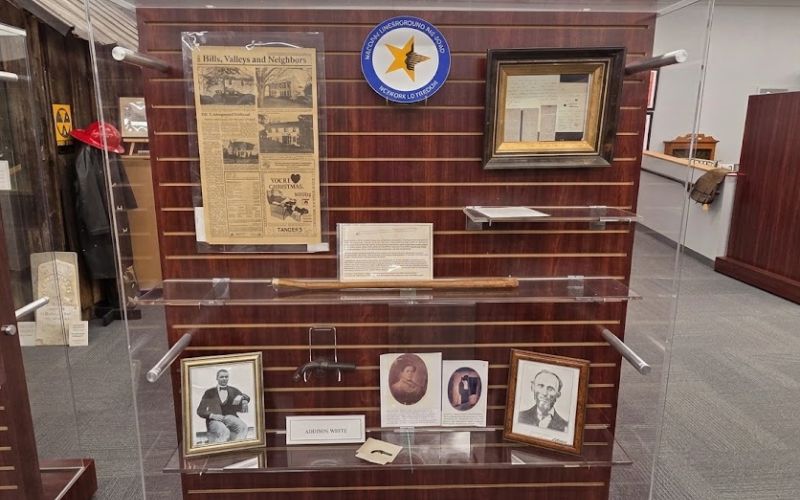
Long before the Underground Railroad became part of local history, Champaign County was part of a network of people, homes, farms, and churches that helped freedom seekers escape slavery and travel north toward freedom.
Two of the most significant stories are those of Lewis Adams, a free Black man who helped operate the Underground Railroad in the Urbana area for decades, and Addison White, a Kentucky freedom seeker whose dramatic confrontation with federal slave catchers in Mechanicsburg demonstrated the lengths local residents would go to resist slavery.
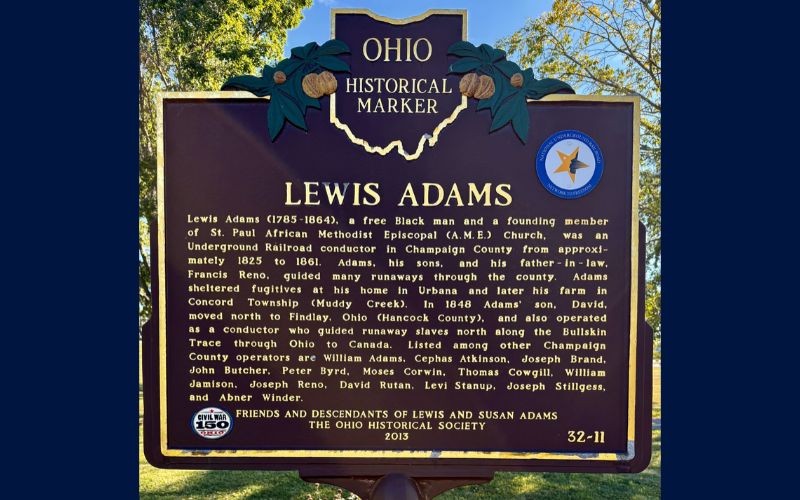
Lewis Adams
Born in 1785, Lewis Adams was a free Black man and a founding member of Urbana’s St. Paul African Methodist Episcopal Church.
Beginning around 1825, Adams became one of the key Underground Railroad conductors in Champaign County. He sheltered freedom seekers at his home in Urbana and later at his farm in Concord Township near Muddy Creek. His sons and father-in-law, Francis Reno, also helped guide people fleeing slavery through the county.
The Underground Railroad was not an actual railroad, but a secret network of people who provided transportation, shelter, and assistance to enslaved people seeking freedom. Homes, farms and churches served as “stations,” while those who helped move freedom seekers were known as “conductors.”
The work was dangerous. Conductors could face fines or imprisonment, while free Black people who assisted freedom seekers risked being captured and forced into slavery themselves.
Adams’ location placed him along an important north-south route. A trail that originally followed buffalo migrations between the Great Lakes and Kentucky became known as the Bullskin Trace. The route eventually became U.S. 68 and provided a path for freedom seekers traveling through Ohio.
In 1848, Adams’ son David moved north along the Bullskin Trace to Findlay, where he continued the family’s work, helping freedom seekers travel toward Ontario, Canada.
Adams remained involved with the Underground Railroad until about 1861 and died in 1864.
His legacy is now recognized at Freedom Grove Park in Urbana, where an Ohio Historical Marker honors Adams and other local Underground Railroad conductors. The marker was also recently added to the National Park Service’s Underground Railroad Network to Freedom Program as a national Underground Railroad Memorial.
Addison White
Several decades after Adams began his work, another important Underground Railroad story unfolded in Mechanicsburg.
Addison White escaped slavery in Kentucky in 1856 and eventually reached Mechanicsburg, where abolitionist Udney H. Hyde provided him with shelter and employment during the winter of 1856-57. White hoped to remain in Ohio while maintaining contact with his wife and children, who remained in Kentucky.
White’s former owner eventually learned where he was. Under the Fugitive Slave Act of 1850, federal authorities could pursue escaped slaves into free states.
On May 19, 1857, federal marshals and slave catchers traveled to Mechanicsburg to arrest White and return him to Kentucky.
White had been warned they were coming. When the officers arrived at Hyde’s home, White climbed into the loft and prepared to resist.
As federal officers entered the home, White fired a weapon. The confrontation alerted the community, and Hyde’s daughter, Amanda, helped notify neighbors. Residents quickly gathered around the house, making it clear the slave catchers would not easily take White away.
The federal officers eventually left without capturing White.
The conflict continued, however. Federal authorities accused Hyde and other Mechanicsburg residents of violating the Fugitive Slave Act. Ohio officials also became involved after federal officers were accused of assaulting a local sheriff.
The standoff was eventually resolved when Mechanicsburg residents agreed to purchase White’s freedom. Accounts differ on the exact amount, but sources agree that local residents raised money to secure his freedom.
No abolitionists were convicted for helping White, demonstrating that the Fugitive Slave Act had not silenced local resistance to slavery.
White’s story continued during the Civil War.
He enlisted in the 54th Massachusetts Volunteer Infantry, one of the first Black regiments in the Union Army. His journey from an enslaved man fleeing Kentucky to a soldier fighting for the Union represented a remarkable transformation.
After the war, White returned to Mechanicsburg, where he lived until his death in 1885.
His story has continued through family histories, poetry, and the stage production Freedom Bound. His descendants have also worked to preserve his story for future generations.
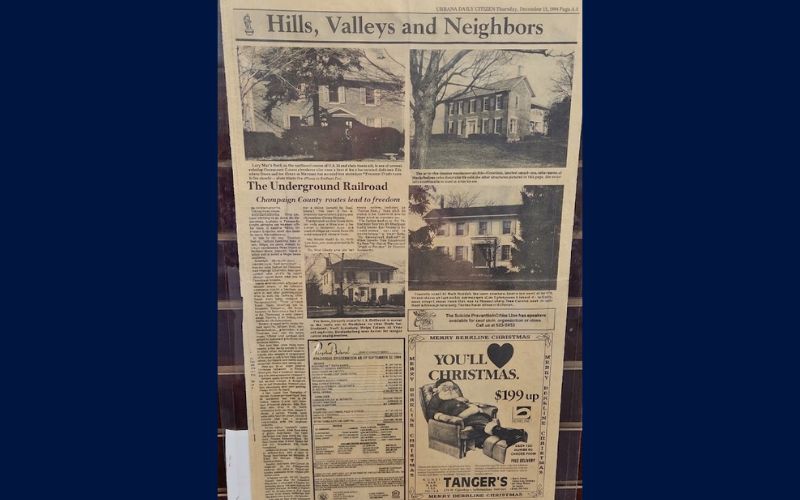
A Lasting Local Legacy
Adams and White experienced the Underground Railroad from different perspectives.
Adams was a conductor who spent decades helping others escape slavery. White was one of the freedom seekers the network was built to protect.
Their stories show that the Underground Railroad depended on much more than a single person or location. It required a network of residents willing to provide shelter, transportation, information and protection — even when doing so meant risking their own freedom.
Historical records identify numerous other Champaign County conductors, including William Adams, Cephas Atkinson, Joseph Brand, John Butcher, Peter Byrd, Moses Corwin, Thomas Cowgill, William Jamison, Joseph Reno, David Rutan, Levi Stanup, Joseph Stillgess and Abner Winder.
Today, the stories of Lewis Adams and Addison White remain powerful reminders of Champaign County’s role in the Underground Railroad — and of the local residents who risked everything to help others find freedom.
All information sourced from Mark Evans, the Champaign County Historical Society, and the Historical Marker Database.