



The following story has been submitted by the Logan County History Center:
By: Mary E. Mortimer
Roy W. Howard spent part of his childhood in Rushsylvania before rising to national prominence as president of the E.W. Scripps Company and chairman of Scripps-Howard Newspapers. In 1912, he became chairman of the United Press board and later served as its president.
Howard was born in 1883 in Butler County, Ohio. While he was still a young boy, his family moved to his father’s hometown of Rushsylvania. His father, William, a former Big Four Railroad employee, left that work after an injury. The family then settled in the village, where he opened a restaurant that sold box lunches to railroad workers. Their stay in Rushsylvania lasted only a few years, but Howard’s connection to the community endured throughout his life.
As a young man, Howard moved to Indianapolis, Indiana, where he began selling the Indianapolis News. He later became a reporter for the newspaper, working alongside fellow Logan Countian Kin Hubbard, creator of the popular “Abe Martin” character.
In 1905, Howard joined the Cincinnati Post, owned by the Scripps-McRae Group, as a telegraph editor. He later became its New York correspondent and wrote a column titled “In New York.” Two years later, when United Press was formed, E.W. Scripps invited Howard to his California ranch and was impressed by the brash young newspaperman. He named him the organization’s first managing editor.
Howard married Margaret Rohe, a newspaper and magazine writer, in London, England in 1909. They made their home in New York City. He continued to play a vital role at United Press and was promoted to first vice president and general manager.
In February 1912, Howard was named chairman of the board of directors while continuing to serve as general manager. On April 17, three days after the Titanic struck an iceberg and sank, he boarded the steamship Olympic bound for Europe. His accounts of the disaster, written during the voyage, appeared in newspapers across the country. In 1914, he became president of United Press. During World War I, he served as a war correspondent in Europe, and his career continued to advance in the years that followed.
Howard resigned from United Press in 1920 to become business manager of the Scripps-McRae Group, a nationwide chain of nineteen publications. Two years later, the company was reorganized as Scripps-Howard. The new firm was led by Robert P. Scripps, succeeding his father, E.W. Scripps, and by Roy W. Howard, who succeeded Milton A. McRae as chairman of the board. By 1928, Scripps-Howard owned twenty-six newspapers across the United States.
In March 1936, Howard made headlines across the country when he interviewed Josef Stalin in Moscow. At the request of the Soviet government, the Scripps-Howard newspapers turned the interview over to United Press and the Associated Press for distribution. Three months later, Howard announced that he was stepping down as chairman of the board at Scripps-Howard, turning the position over to William W. Hawkins while continuing to serve as chairman of the executive committee. He also served as president and editor of the New York World-Telegram.
Howard’s son, Jack, joined the staff of the United Press European division after graduating from Yale University in 1932. He became president of Scripps-Howard Radio in 1937.
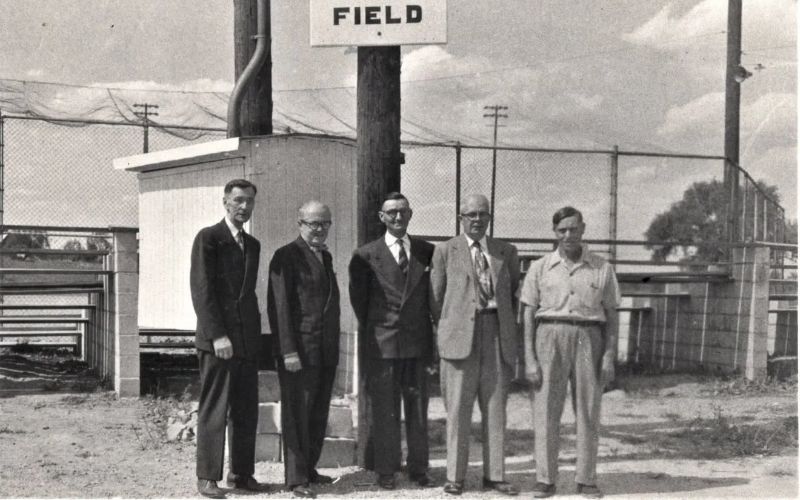
In July 1950, the village of Rushsylvania named its new athletic field in honor of Roy Howard. At the dedication ceremony, the Rev. Elmer Rogers of the Church of Christ told the large crowd of attendees that Howard was the most successful citizen ever to come from Rushsylvania. He recounted how Howard had begun as a newspaper boy at age 15, became a reporter two years later, was named president of United Press at 29, and rose to head Scripps-Howard Newspapers at 38. Howard sent a check for $500 to be used for the new athletic field. He was unable to attend the dedication because he was traveling in South America.
Roy Howard announced his retirement in early 1953, and his son, Jack, moved from executive vice president to president and general manager, continuing the Howard family’s place in American newspaper history. He remained chairman of the executive committee. The E.W. Scripps Co. served as the operating company for the nineteen Scripps-Howard newspapers.
Rushsylvania warmly welcomed Howard home in July 1953 for his first visit to the village in more than thirty years. Three years earlier, the community had dedicated its athletic field in his honor. Howard and his family flew to Marion, Ohio, in their private plane, piloted by two World War II veterans. Howard remarked that his work as a newspaperman had taken him more than 700,000 miles by air. He was accompanied by his wife, Margaret; his son, Jack; and Jack’s wife, Barbara. Known for his dapper style, Howard wore one of his signature suits and bow ties. Rollo Best, Mayor James Kerns, Herman Royer, and Rev. C. L. Harris met the family at the airport.
During the visit, Howard paid his respects at the graves of his father and grandparents. His maternal grandfather, the Rev. Howard Alexander, had served as a Presbyterian minister in the village in the early 1900s. Later that day, Howard toured Rushsylvania’s business district before attending an old-fashioned ice cream social at the school. Those who visited with him were amazed by his ability to recall their names and the fun they had shared as children.
In 1960, at age 77, Howard announced his retirement from the New York World-Telegram and Sun, a position he had held for thirty-three years. Although Roy W. Howard attained national recognition in American journalism, he maintained a lasting connection to Rushsylvania, the small Logan County village that remained an important part of his personal history.
Visit the Logan County History Center to learn more about Logan County history. The History Center is open for tours Wednesday through Sunday from 1:00 p.m. to 4:00 p.m. Admission is free.


