
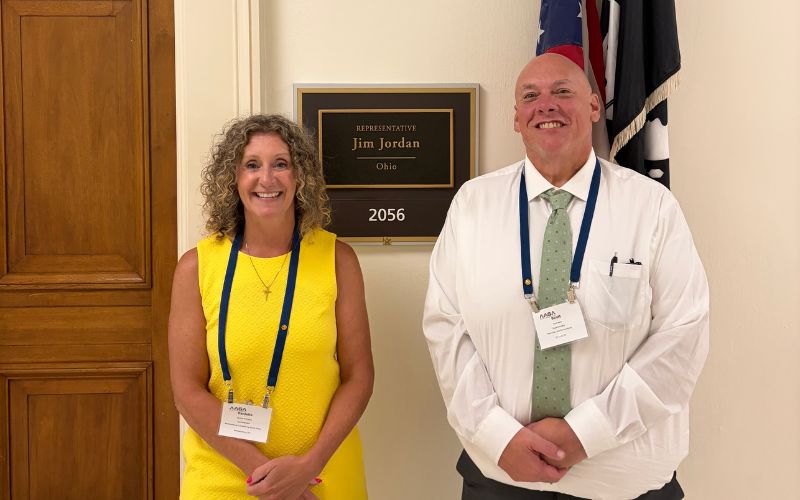
Two local Ohio public school superintendents traveled to Capitol Hill on July 8 to advocate for public education funding and defend local control of schools as members of the Governing Board for AASA, The School Superintendents Association.
Dr. Danielle Prohaska, superintendent of Mechanicsburg Exempted Village School District, and Dr. Scott Mann, superintendent of Riverside Local Schools, met with congressional staff representing U.S. Rep. Jim Jordan, U.S. Sen. Jon Husted, and U.S. Sen. Bernie Moreno to discuss federal education policies they say could significantly impact Ohio school districts.
During the meetings, the superintendents reviewed the Fiscal Year 2027 federal education appropriations bill. According to the proposal approved by the U.S. House, the Department of Education would see an $8.1 billion, or 10%, funding reduction. The proposal would eliminate Title II funding for effective instruction and Title III funding for English language acquisition while reducing Title I funding by $1.9 billion.
“Our local districts are already battling stark inflationary increases in healthcare, transportation, and daily utilities. We came to Washington to urge Congress to protect core formula grants so we can maintain baseline services for our students.”
— Danielle Prohaska, Mechanicsburg Exempted Village Schools Superintendent
A primary focus of the visit was the federal government’s commitment to fully fund the Individuals with Disabilities Education Act (IDEA). Congress pledged in 1975 to cover up to 40% of the additional costs associated with special education services, but school leaders noted that the federal government currently provides only about 10%, leaving state and local taxpayers responsible for the remainder.
Prohaska and Mann urged all three congressional offices to support the bipartisan IDEA Full Funding Act, which would establish a 10-year plan to reach the originally promised funding level.
The superintendents also raised concerns about the increasing financial burden on school nutrition programs resulting from new federal nutrition mandates. They said the cost of preparing a school meal has climbed to approximately $4.70, while current federal reimbursement rates have failed to keep pace with rising expenses.
Mann also emphasized the importance of maintaining local authority over school technology decisions, particularly in response to the Federal Communications Commission’s proposal to narrow the definition of the E-Rate program. The program provides schools with critical funding to support internet connectivity and digital infrastructure.
“E-Rate was created by Congress as a connectivity tool. Decisions regarding cell phone policies, screen limits, and digital literacy belong exclusively to local school boards, our communities, and the state, not federal regulators in Washington.”
— Scott Mann, Riverside Local Schools Superintendent
The superintendents asked Husted’s office to use the senator’s background in technology and government efficiency to help oppose what they described as federal regulatory overreach that could limit local flexibility.
Student online safety was another topic discussed during the Capitol Hill meetings. Prohaska and Mann expressed support for the Senate-passed versions of COPPA 2.0 (S. 836) and the Kids Online Safety Act (KOSA, S. 1748). They said protecting children online is essential but argued that responsibility for enforcing safety standards should rest with technology companies rather than school districts.
Following the meetings in Washington, both superintendents returned to Ohio to continue leading their respective districts while remaining engaged with their congressional representatives on federal education policy.