The following has been submitted by the Logan County History Center:
By: Mary E. Mortimer
The village of West Mansfield was laid out in 1848 by Levi Southard, who owned a farm on the site. Southard began selling lots almost immediately and named the new village in honor of his one-year-old son, Mansfield. In November 1861, he enlisted in the 13th Independent Battery, Ohio Volunteer Artillery. He rose to the rank of sergeant and died in June 1862 in a hospital in Savannah, Tennessee.
According to the History of Logan County, published in 1880 by O.L. Baskin, West Mansfield once had the nickname of “Fip Town.” The name was said to have originated in the village’s early days, when a company of surveyors stopped at its only store for a lunch of crackers and cheese, which the storekeeper could not supply. “Well,” said one of them, “we will call this place ‘Fip Town.’”
West Mansfield’s early years centered on the work of building a community. Bliss Danforth built the first house, an eighteen-by-twenty-foot round-log structure, followed by homes built by Ellis and Henry Baldwin. John Coussins kept the first tavern, while Samuel Danforth and William Keller operated an early store. Other firsts included James Wilgus’s shoe shop, blacksmith shops run by Mark Austin and John Coussins, and John Robinson’s service as postmaster, with mail transported daily from Bellefontaine.
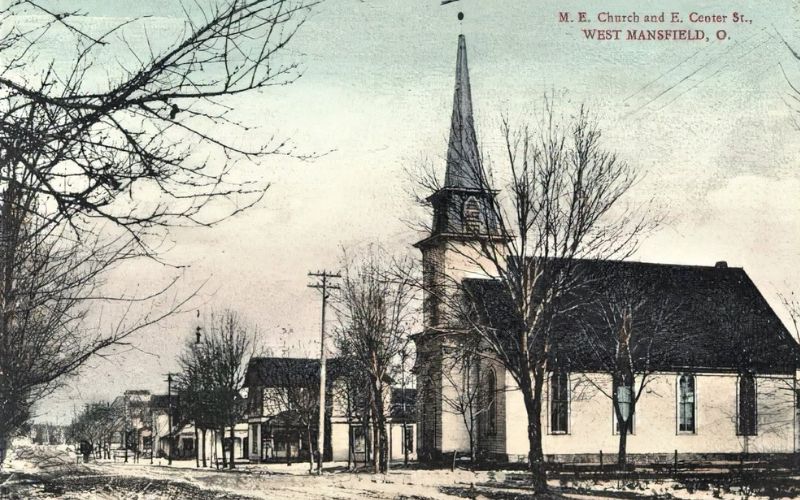
Churches and schools soon became part of village life. The Wesleyan Methodists began meeting in the schoolhouse in 1843, though they disbanded after about three years. The United Brethren met in the schoolhouse as early as 1845 and built the first church in West Mansfield in 1852, followed by a second church in 1877. The Methodist Episcopal denomination organized a church in 1869.
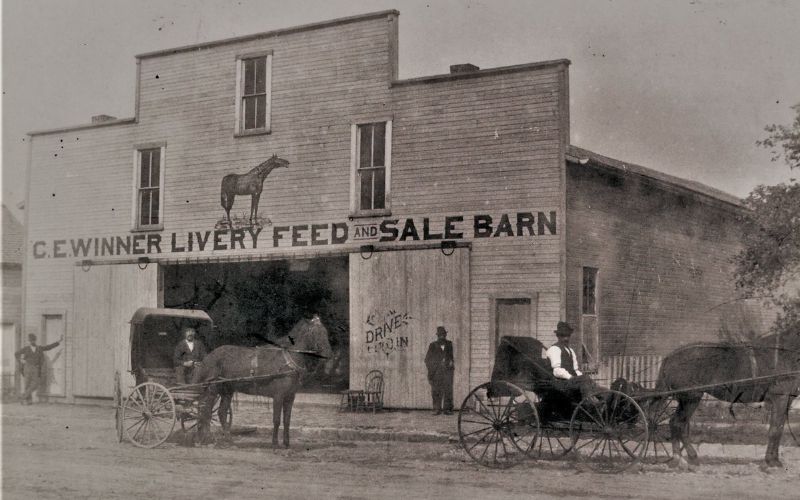
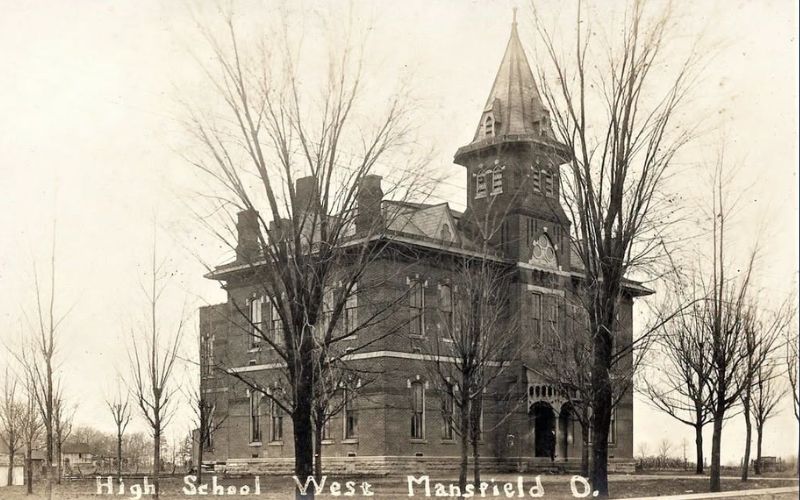
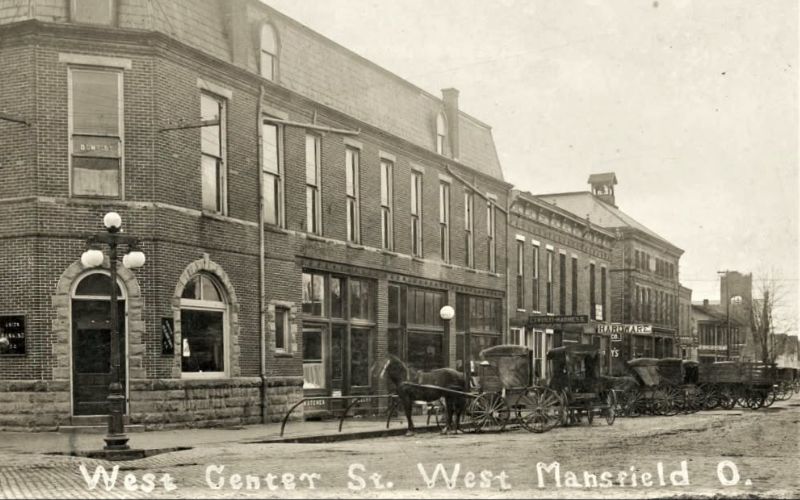
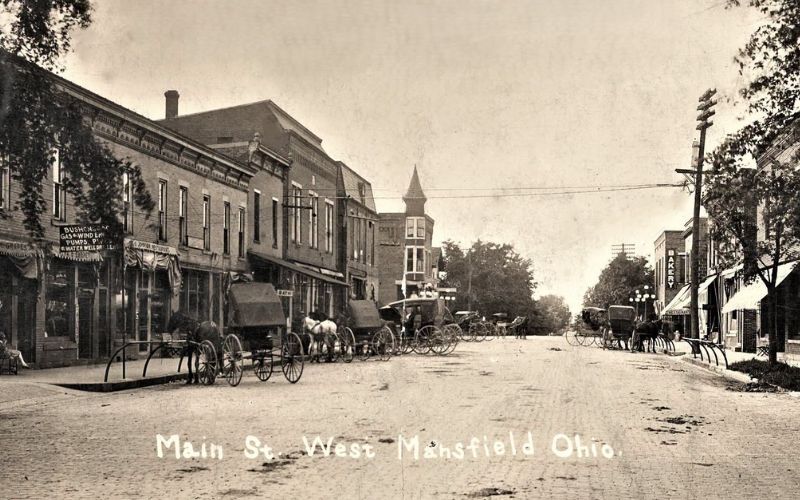
The second schoolhouse, built in 1873, was a large brick structure that reflected the village’s growth. By then, West Mansfield also had two hotels, kept by Henry Hathway and V. Southard, along with two dry goods stores, a drug store, a hardware store, a wagon shop, a harness shop, and a sawmill operated by William Bushong and Ham McDonald.
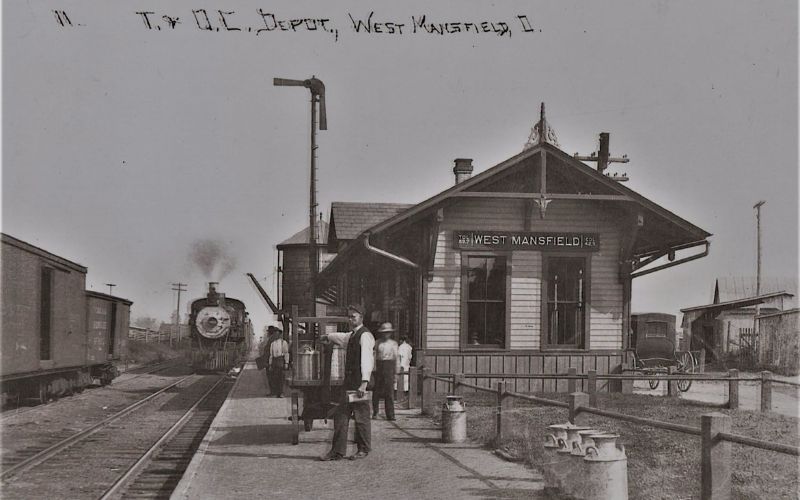
West Mansfield was incorporated in 1879, and a new era arrived in July 1893, when the first T. & O.C. Railroad train steamed into West Mansfield. Residents welcomed the occasion with a large dinner for “the tracklayers and all others concerned” and a celebration said to have “laid ‘Old Fourth of July’ in the shade.” About 100 residents rode the first excursion train from West Mansfield to Marysville. The round-trip cost 25 cents, and the first passenger train reached the village in September 1893.
Gen. Robert P. Kennedy later remarked in his Historical Review of Logan County published in 1903, that “West Mansfield has grown rapidly since it has secured a railroad.” He described the village as “one of the thrifty, thriving, growing and most prosperous towns in the county,” with a bank, a handsome city hall, and “almost every kind of business.”
Industry also shaped West Mansfield’s history. Simpson Van Cleve moved to the village in 1881 and became interested in making drainage tile. He partnered with H.E. Southard and Thomas F. Wilson to form the Van Cleve Clay Manufacturing Company. After a major fire destroyed its buildings in 1900, the company quickly rebuilt and flourished, shipping tile to many parts of the country and becoming one of Ohio’s largest manufacturers of drainage and building tile. The company remained successful into the 1920s.
In the early 1950s, the former industrial site took on a new community purpose. The area where the Van Cleve Clay Manufacturing Company once operated was drained, and a dam was built to create a 13-acre lake. The West Mansfield Conservation Club was formed and incorporated in 1955. In addition to the lake, the club built a popular trap-shooting range, and over the years hosted many community events, including turkey raffles, fox drives, ox roasts, euchre and dance parties, and monthly fish fries.
Like many small towns, West Mansfield saw business activity slow after railroad operations ceased. Yet the village endured, continuing to serve as a strong community with a present-day population of approximately 766 people.
Visit the Logan County History Center to learn more interesting aspects of Logan County History. The History Center is open for tours Wednesday – Sunday from 1:00 pm to 4:00 pm. Admission is free.